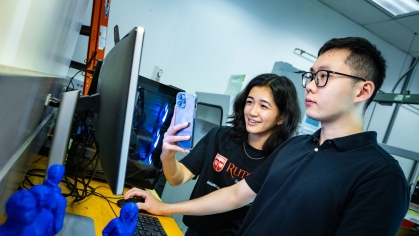
Rachel Eden Fu Ren Wesley has always been curious about how things work – and how to improve them, which prompted her to pursue a master’s degree in industrial engineering at Rutgers.


Do you look around and wonder how to make things better?
Do you want to make everyday processes more efficient, safer, less expensive, and environmentally sustainable?
Are you challenged to solve the problems others can't see?
Rutgers' Industrial Engineering program teaches students how to figure out large problems and optimize systems.

With current advances in data capturing technology, different kinds of information sources and sensor signals are increasingly used to assess the quality of products and processes in many industries, including the automotive industry, electronics and semiconductor manufacturing, and stamping and chemical processing.
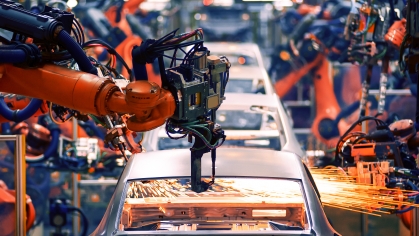
Main interests include investigating advanced manufacturing processes to produce discrete products at micro-scales and related production and manufacturing systems for achieving high quality, reliability, efficiency, and better sustainability as related to the interaction of people, machines, materials, products, computers, sensors, energy sources, and environmental factors.

Reliability and quality in industrial engineering ensures a system's proper function over a period of time and various conditions.

Developing value-based metrics and practices within the energy sector that will help measure energy efficiency, not only in terms of savings in costs and reductions in carbon footprints, but also increased productivity and performance.

Advancing the interplay of autonomous systems and control with robotics and AI. This integration includes digital Twins and simulation, system integration, intelligent transportation, and smart cities and buildings.
Rachel Eden Fu Ren Wesley has always been curious about how things work – and how to improve them, which prompted her to pursue a master’s degree in industrial engineering at Rutgers.
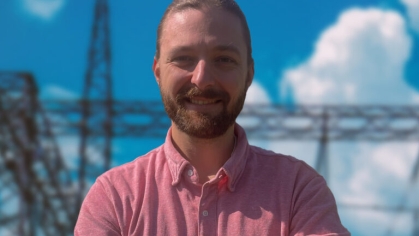
Learn more about assistant professor Robert Mieth whose research focuses on operation and planning of renewable-dominant power and energy systems in the context of climate change.

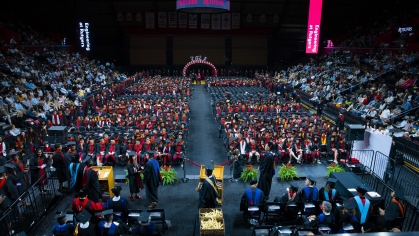
Friday, May 10, 2024, 10:00 a.m.-12:30 p.m. | Jersey Mike’s Arena, Livingston Campus